
For commercial cultivation, dry soluble nutrients give you more concentration, lower cost per gallon, and much tighter control than liquid concentrates. When those dry inputs are organized into a complete system, like Front Row Ag’s three-part A/B/Bloom base with defined EC contributions and proven mixing methods, you get a feed program that behaves like the rest of your facility: measurable, repeatable, and easy to scale.
Instead of shipping, storing, and diluting water-heavy liquids, you bring in compact dry bags, convert them into direct-to-reservoir solutions or validated stock concentrates, and verify every batch by EC and pH. The result is less variation between rooms, fewer hidden problems in the rootzone, and a more predictable path to yield, quality, and profitability.
When “Almost the Same” Isn’t Good Enough
In a modern facility, most of the big variables are already controlled. You’ve mapped PPFD, tuned HVAC, locked in irrigation schedules, and standardized plant handling. Yet you still see it: two rooms with the same genetics and environment, and one quietly underperforms. Not a disaster, just slightly less density, a touch more stretch, a little less consistency at harvest.
When you dig into those differences, they often trace back to something upstream of the dripper: how nutrients are stored, mixed, and delivered. Liquid concentrates can look convenient on paper, but they introduce a lot of silent variability, especially when multiple people are diluting and handling products across shifts.
Front Row Ag starts from a different premise. If you treat nutrition as a system instead of a set of bottles, you can remove that noise. Dry solubles are the foundation; the structure around them is what turns them into a reliable tool.
Where Liquid Programs Quietly Cost You
Liquid concentrates became popular because they appear simple: pour, top up, stir, and feed. At a commercial scale, three issues tend to show up over and over.
You’re Paying to Move and Store Water
Liquid concentrates are mostly water. That means you’re paying freight on weight that doesn’t feed plants, and you’re dedicating pallet positions and floor space to drums and totes that are largely carrier water and stabilizers. As facilities expand, this storage footprint starts competing with more valuable uses of space like finished product staging, media storage, or additional canopy.
Dilution Adds Human Error
Even with “concentrated” liquids, you still need to dilute into a stock tank or day tank. Every time a tech eyeballs a level, pours from a heavy jug, or rushes a top-off, there’s room for small but meaningful variation. A few extra milliliters of a low-strength liquid here, slightly too much top-off water there, and suddenly your feed EC is not what you think it is. Across weeks and rooms, that inconsistency shows up as uneven rootzone EC and plant response that’s hard to track down.
Extra Ingredients You Didn’t Ask For
To sit stable in a jug, liquid fertilizers need stabilizers, preservatives, and other carriers. They matter for shelf life, but they don’t add nutritional value. They still count toward cost, and they still show up in your solution as extra dissolved load. When your goal is a clean, predictable mineral profile, those passengers don’t help.
None of this means liquid products “don’t work.” But it does mean that as you scale, they carry hidden operational drag and variability that you have to manage around.
The Front Row Ag Dry Soluble System
Front Row Ag starts with the same basic reality as any nutrient line: plants only care about ions in solution. Whether you begin with a dry salt or a liquid, everything must dissolve into water before roots can take it up. The difference is how much control you have over that solution.
A/B/Bloom: A Complete, High-Concentration Base
Front Row’s core is a three-part dry base:
- Part A: Calcium and full micronutrient package
- Part B: Phosphorus, potassium, magnesium, and sulfur
- Bloom: Phosphorus and potassium for reproductive growth
Each product is highly soluble and designed to be used together from clone through finish. The important detail for your team is that each part has a known “contributed EC per gram per gallon” (for example, Part A contributes more EC per gram than Bloom). You don’t need to memorize the numbers; you need to understand what they enable:
- Feed charts are built from those contributions, so target EC is calculated, not guessed
- After mixing, your meter reading should match what the math predicts
- If it doesn’t, you know to look for a mixing, volume, or meter issue before you irrigate
Front Row is designed to support both hands-on batch mixing and automated fertigation.
Direct-to-Reservoir (DTR)
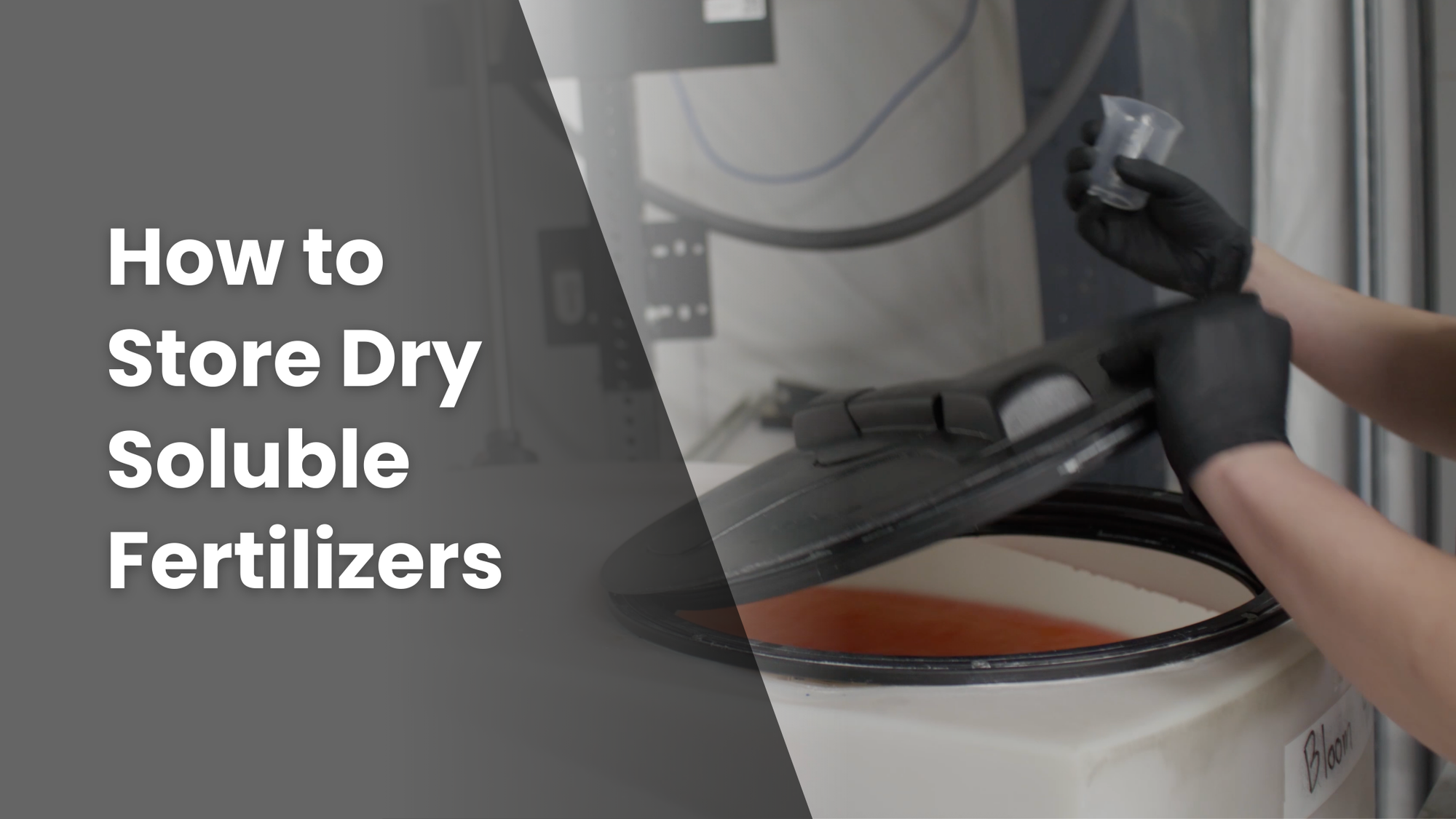
You weigh and add product directly to your batch tank in a defined order, silica (if used) → Part A → Part B → PhosZyme → Bloom, allowing time for each to fully dissolve. You then adjust pH into the ideal range and verify final EC and pH before feeding. This is ideal for batch operations or smaller sites that want simple, visible control.
Stock Concentrate (3-2-2 method)
Here, you convert dry bags into dense stock solutions, commonly three bags of Part A, two of Part B, and two of Bloom, each into its own 50-gallon stock tank. Those stocks are validated using a simple dilution test of pulling a measured volume of stock into a measured volume of RO water and checking that EC matches Front Row’s reference values. Once they do, those stocks can feed an injection system or be used to quickly build batch tanks with very little day-to-day weighing.
Because you start from compact dry bags, you dramatically reduce your shipping and storage footprint compared to a liquid program. And because your stocks are validated, every injection event is pulling from a known, repeatable concentration.
Additives That Fit the System
Front Row’s additives are designed to plug into this framework instead of bolt on from the side:
- Front Row Si: Stabilized silicic acid for structural strength and stress tolerance, with clear guidance on how long reservoirs containing it should be used before refresh.
- PhosZyme: Phosphorus and enzyme technology blended into the program at defined rates, with its EC impact accounted for in the charts.
- Triologic: Microbial inoculant to support root development and nutrient cycling early in the crop.
- BioFlo and sanitation tools: To manage biofilm and keep fertigation infrastructure clean without disrupting the nutrient profile.
The idea is simple: your base program covers plant nutrition; additives are tools that extend performance without breaking the underlying system.
Principles for System-Driven Feeding
Moving to a dry soluble program is not about making life more complicated. It’s about putting structure around what you already do.
Start From a Clean Slate
Front Row feed charts are written assuming reverse osmosis (RO) water at essentially 0.0 EC. That doesn’t mean you can never use tap or blended water, but it does mean you need to understand your baseline. Starting from RO simplifies everything: every unit of EC in your reservoir came from a product you intentionally added.
Treat EC as a Steering Wheel, Not a Sticker
With Front Row, most facilities settle somewhere between 2.0 and 3.0 EC for feed strength. Where you sit in that range depends on pot size, media, irrigation frequency, PPFD, CO₂, and cultivar demand. Early in the cycle and through stretch, higher EC supports rapid growth. As the plant finishes building structure and shifts toward ripening, the program tapers EC so you’re not carrying unnecessary salts into late flower.
The key is that these moves are planned. You’re steering EC to match plant demand, not discovering after the fact that a batch was stronger or weaker than you thought.
Keep pH in the Sweet Spot
Front Row is formulated to stay soluble and available in the standard hydroponic range. In practice, that means you want feed solution pH in the high fives to about 6.0 at the tank. Letting pH drift higher can work against micronutrient availability and may encourage precipitation over time.
This is why the mixing order matters, and why Front Row pH Up is dosed in small, measured amounts at the very end. When pH is managed deliberately, your micronutrient profile stays in solution the way it was designed.
Validate, Don’t Assume
The contributed EC values and stock validation process are not “extra steps,” rather, they’re your insurance policy. A quick check on a sample from each stock tank and on every DTR batch takes minutes and confirms that:
- You weighed correctly
- Your volume is correct
- Your meter is reading in line with expectations
Those checks give you confidence that what’s leaving the dripper is what you think it is, which goes a long way toward de-mystifying plant response.
What This Looks Like Day to Day
In practice, once the SOPs are in place, a Front Row dry program runs simply. Here’s a direct-to-reservoir example:
- Fill the batch tank with RO water and start agitation
- If you’re using Front Row Si as a drench, add it first and mix thoroughly
- Add Part A, allow it to fully dissolve; then Part B; then PhosZyme; then Bloom, with mixing between each
- Adjust pH into the target range
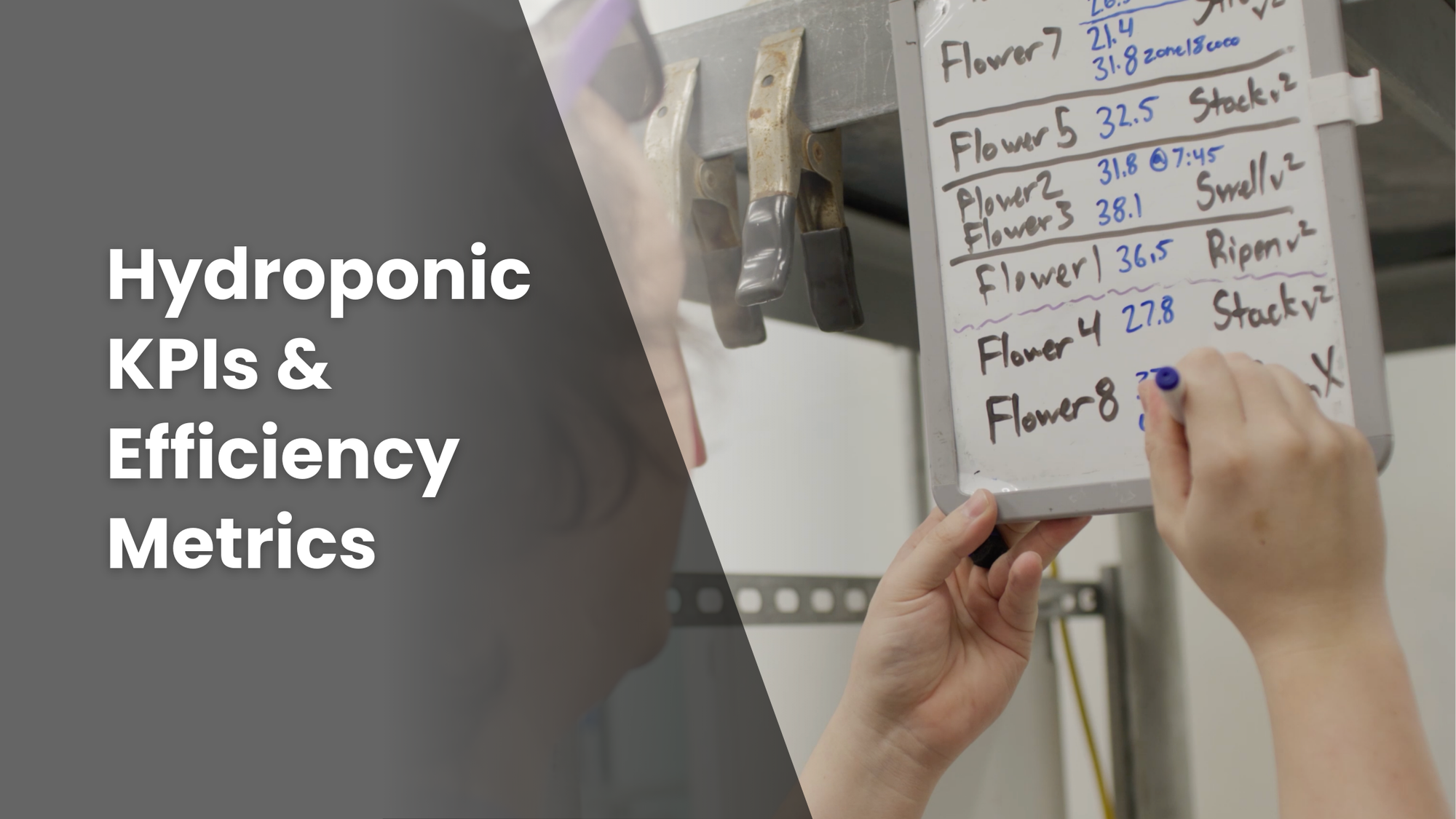
- Confirm EC and pH match your chart for that phase and room, record the readings, and release to irrigation
Reservoirs that contain Si are typically used within a short window (on the order of 48 hours). Without Si, a clean, well-managed reservoir can usually be run for several days before being remade. Here’s a stock concentrate example:
- Partially fill each stock tank (A, B, Bloom) with RO water
- Add the full bag count for that method (for example, 3 bags A, 2 bags B, 2 bags Bloom into separate tanks for a 3-2-2 setup)
- Mix thoroughly and top each tank to its marked volume
- Pull a small, measured sample from each, dilute into RO water as specified, and check EC against Front Row’s validation values
- Once validated, connect stocks to the injection system or use them to quickly build batch tanks at the correct ratio
From there, your daily routine is straightforward: verify stock levels, spot-check EC and pH at the reservoir and a few drippers, observe runoff or substrate data, and make small, systematic adjustments as needed.


Frequently Asked Questions
Beyond cost, what’s the real benefit of dry solubles vs. liquids?
From the plant’s perspective, nutrients are just ions in solution. The difference is in how you get there. Dry solubles like Front Row deliver a higher percentage of active nutrient per unit you ship and store, with fewer stabilizers and fillers. Because the system is built around known EC contributions and validated mixing methods, you get a cleaner, more predictable nutrient solution and a more stable rootzone over time.
How should my team actually use the “contributed EC” concept?
Think of it as a built-in audit tool. The feed charts already translate grams per gallon of each part into a target EC. When you follow a recipe at the correct volume and then measure EC, your reading should be very close to that target. If it’s not, that’s your signal to check weighing, volume, or meter calibration before you irrigate. You don’t have to run math every day, but knowing the relationship between grams, gallons, and EC makes troubleshooting fast and objective.
We’re on a liquid program now. How do we move to Front Row without shocking plants?
The smoothest transitions start with a water check and a pilot. Confirm what’s in your source water and decide whether you’ll run full RO or a treated blend. Then pick a defined block (one room, one zone) and match your current EC while you introduce Front Row’s phase-appropriate recipes. Watch plant response and substrate EC/pH closely, and adjust EC and irrigation strategy in small steps. Because the Front Row base is complete, you don’t need to stack on extra CalMag or multiple bloom boosters; you simply move the entire recipe up or down as needed while maintaining the intended ratios.
Making Nutrition as Predictable as the Rest of Your Operation
When you step back and look at your facility, almost everything else is already being treated as a system. From lighting to HVAC down to irrigation and labor, each has clear setpoints, controls, and feedback. Nutrients should be no different.
Dry soluble fertilizers on their own are just ingredients. Front Row Ag turns them into a structured platform: a three-part base that covers the full cycle, defined EC contributions that make recipes verifiable, stock and direct-to-reservoir methods that fit both batch and automated operations, and additives that support the system instead of complicating it. The payoff is simple, fewer surprises, more consistent rooms, and a clearer link between what you feed and what you harvest.