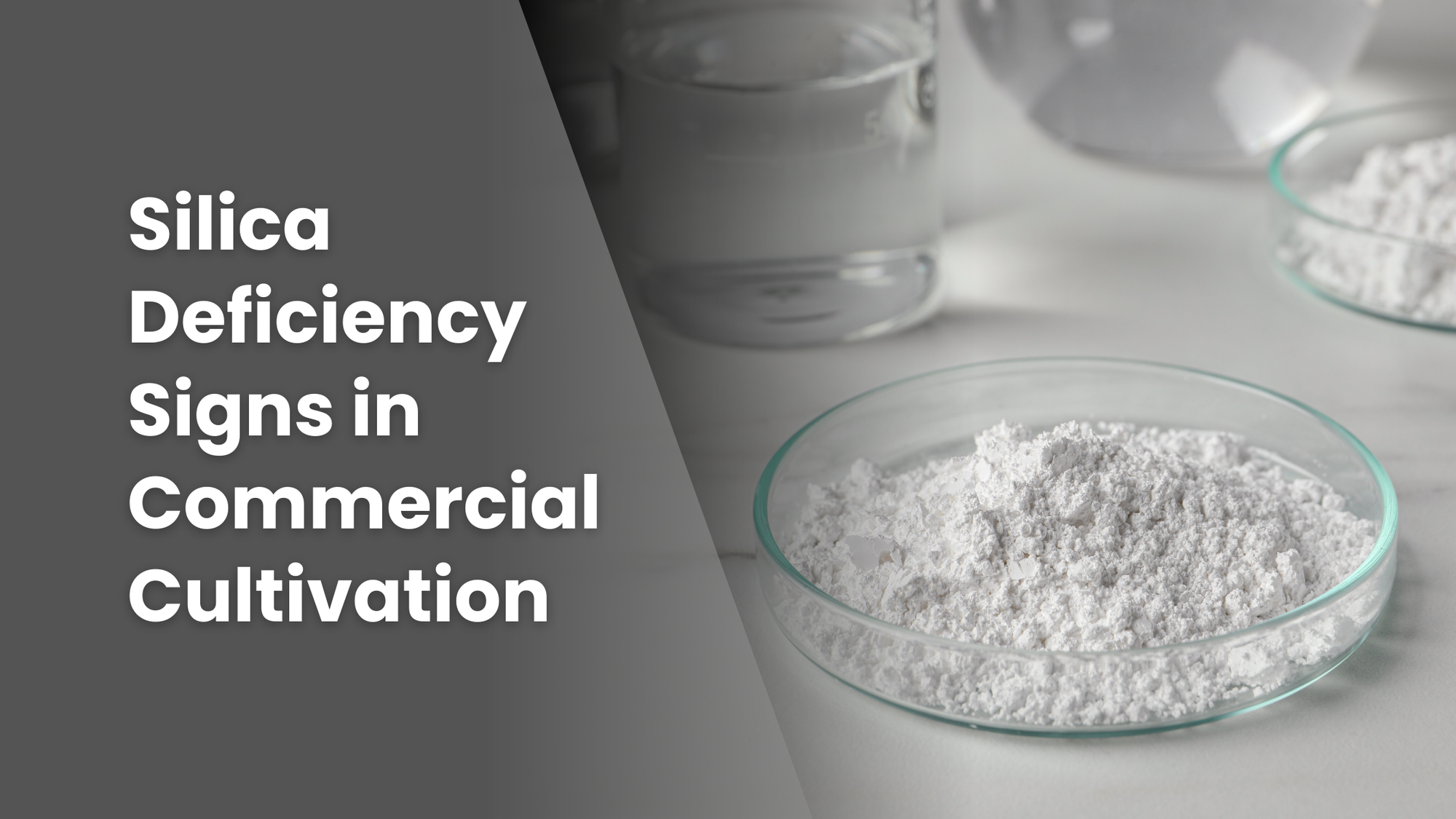

This article explores Silicic acid, the fully bioavailable form of silicon taken up by plant roots. In hydroponic and soilless systems, where natural silicon release from minerals is minimal or effectively absent, supplementing stabilized silicic acid can improve cell-wall strength, stem rigidity, water-use efficiency, and abiotic stress tolerance. Applying it at the correct concentration, pH, and timing can prevent precipitation, enhance nutrient balance, and improve plant structural support from veg through early flower stages. In commercial cultivation, silicic acid can function as one of the key hydroponic nutrient additives that supports consistent morphology and lowers mechanical failure risks in high-yield environments when used within a balanced fertigation program.
Why Silicic Acid Matters
Silicic acid, known chemically as monosilicic acid or orthosilicic acid, is the fully dissolved form of silicon that plant roots absorb directly. In natural soils, this form appears gradually as silicate minerals weather. In contrast, recirculating systems and inert substrates like rockwool, coco, and perlite provide no meaningful ongoing source of plant-available silicon. Potassium silicate, a common alternative, must convert into silicic acid before plants can use it, and that conversion depends heavily on pH and contact time. This is why growers often see inconsistencies when relying on silicate salts rather than stabilized silicic acid. Pre-formed silicic acid eliminates conversion steps and delivers consistent availability across the pH range used in fertigation and does so without adding extra potassium or significantly affecting solution EC or pH.
In hydroponics, this bioavailability matters because nutrient solutions move quickly through inert substrates, and there is no soil matrix acting as a slow-release reservoir. The plant either receives silicon through the feed water or not at all. Stable silicic acid in hydroponics can create a predictable supply that integrates cleanly with calcium-nitrate-based nutrient programs and maintains solubility without clouding or precipitation when added in the correct order and used at appropriate rates.
Silicic Acid Application Benefits
Controlled-environment crops with rapid internodal extension, high biomass turnover, and dense flower formation can be especially responsive to silicon. Once absorbed through the roots, the silicon deposits into cell walls as biogenic silica. This reinforcement can produce thicker epidermal tissues and sturdier vascular pathways, leading improvements in stem rigidity, branch stiffness, and the plant’s ability to hold weight during the late flowering stage. It’s not normally used as a registered pesticide, but once silicon is deposited in plant tissues, it can also act as a structural and physiological biostimulant creating a physical barrier that makes it more difficult for insects and pathogens to penetrate, supports water balance and nutrient uptake, and helps activate plant immune and antioxidant systems. Silicon can also influence water management by supporting tighter stomatal regulation under heat or vapor pressure. Plants grown with adequate silicon can often show reduced leaf wilt during peak light hours, especially in rooms operating at higher Photosynthetic Photon Flux Density (PPFD) and elevated leaf-surface temperatures. The root-zone also benefits, as silicon supports stronger cell-wall formation within root tissues, helping maintain cation balance during aggressive nutrient uptake in early vegetative growth.
To put it simply, growers using stabilized silicic acid typically observe increases in overall plant structural support, such as stronger stems, more uniform upright growth, and improved branch structure, with plants maintaining better posture under high airflow conditions. Additionally, they can see improved nutrient-use efficiency. Reinforced epidermal layers can reduce unnecessary water loss, stabilizing nutrient concentrations inside the plant even when electrical conductivity (EC) fluctuates slightly due to environmental changes.
Silicic Acid in Hydroponic Systems
Because hydroponic systems don’t supply silicon on their own, plant roots receive very little plant-available silicon unless the grower adds it. Silicic acid remains stable and soluble in typical hydroponic pH ranges, generally between 5.5-6.0, and can mix cleanly with calcium-containing fertilizers when added in the correct order. In systems using stabilized monosilicic acid, silicon’s effect on a solution’s pH is minimal compared to traditional silicate salts.
In these fast-draining, low-CEC systems, silicic acid should be present at consistent concentrations in each irrigation event. In recirculating systems, stabilized silicic acid prevents the precipitation that commonly occurs when potassium silicate interacts with calcium or magnesium. Clean solubility is important not only for your plant uptake but also for maintaining emitter cleanliness and avoiding reservoir clouding. When using stabilized silicic acid products in a ready-to-use reservoir, it’s best to completely turn over the solution within roughly 48 hours, but similar nutrient solutions can typically be held for longer (5-7 days) when silicon is not present.
Proper Application and Mixing of Silicic Acid
Silicic acid is straightforward to use when added in the correct order. It performs best when introduced to clean water before calcium-nitrate sources, as this prevents interactions that can cause clouding or temporary gel formation. When growers mix from scratch in a direct-to-reservoir process, silicic acid should be added immediately after the water, followed by calcium-containing parts of the nutrient program, and finally by phosphorus and potassium-heavy components. However, if you need to lower pH with pH Down, do that first before adding your silicic acid.
Dosage depends on your nutrient goals and overall feed EC. With a concentrated monosilicic acid product like Front Row Si, 0.5 milliliters per gallon in the root zone typically delivers low-teens ppm of plant-available silicon. Our practical root-zone guidance is a graduated scale: 0.5 mL/gal below 2.3 EC, 0.375 at 2.3-2.7, 0.25 at 2.7-3.1, 0.125 at 3.1-3.5, and 0 above 3.5 EC. Uptake slows in the mid to late flower stage because most structural development has already occurred, so many growers taper or discontinue silicon after week three or four of the generative phase.
Foliar application is another efficient way to deliver monosilicic acid without affecting feed EC. Many commercial cultivators apply stabilized silicic acid as a foliar spray at roughly 0.5-2.0 mL/gal once per week from vegetative growth through about day 21 of flowering. This strategy front-loads silicon during the period of most rapid structural development.
When silicon is introduced through stock tanks, only stabilized silicic acid should be used. Potassium silicate is typically incompatible with concentrated mixes because it can precipitate with calcium and magnesium. Stabilized silicic acid, such as Front Row Ag Si, remains clear and maintains solubility across common injection ratios. In stock-concentrate systems, silicon is typically mixed into its own dedicated stock solution at a defined rate and injected so that the final ready-to-use solution lands in the same 0-0.5 mL/gal equivalent range as direct-to-reservoir programs.
Silicon Supplementation With a Three-Part Nutrient Program
Silicic acid works well alongside a balanced three-part formula such as the Front Row Ag Craft Grower Bundle. Because the base nutrients supply calcium, magnesium, nitrogen, and micronutrients without added silicon, silica supplementation completes the structural portion of the plant’s nutritional profile. Silicic acid also works cleanly with supporting products such as Front Row Ag’s BioFlo and PhosZyme. Clean root surfaces maintained by enzymatic products can enhance silicon mobility, while surfactant technologies improve solution distribution across different substrates.


Common Silicic Acid Issues
Cloudiness or gel formation in the reservoir usually indicates that the silica source was added too late in the mixing sequence or that a non-stabilized silicate salt was used. Adding silicic acid at the beginning of the mixing process can prevent this problem. Weak stems despite silicon use often point to environmental or nutritional factors such as insufficient calcium, or overly rapid growth caused by high nitrogen or excessive EC. While silicon can’t compensate for fundamental imbalances, it can help stabilize growth once those are corrected. Another common issue, pH drift after mixing, is commonly associated with potassium silicate or with aggressive use of alkaline additives. Stabilized monosilicic acid products used at recommended rates have a much smaller impact on pH. If upward drift occurs, verifying the source and ensuring proper mixing order can usually resolve the issue. In drip systems, emitter clogging can happen when undissolved particles accumulate in the lines, but stabilized silicic acid dissolves fully and passes cleanly through typical agricultural filtration, minimizing this risk when the rest of the nutrient program is also well balanced and properly filtered.
Frequently Asked Questions
Is silicic acid necessary in coco?
Coco contains only trace levels of plant-available silicon, so supplementation is recommended for consistent structural integrity and to support stress tolerance in high-intensity environments.
Can silicic acid replace calcium for strengthening stems?
Silicon and calcium play different structural roles. Calcium forms part of the pectin matrix inside cell walls, while silicon reinforces the cell exterior. Both are necessary for strong, resilient growth.
Does silicic acid affect terpene production?
Most published silicon research focuses on biomass, yield, disease pressure, and stress tolerance rather than terpene profiles. Any terpene effects are likely indirect (arising from overall improvements in plant health and stress management) rather than silicon acting as a dedicated terpene booster.
Should silicic acid be used during late flowering?
Most structural development occurs by the end of the stretch stage. Many growers discontinue silicon after week three or four of flower without negative effects, and foliar silicon programs commonly stop around day 21 of flower.
What is the best way to mix silicic acid into a hydroponic reservoir?
Try adding silicic acid to clean water before any calcium-containing nutrients to prevent precipitation and maintain solution clarity. If you need to lower pH with pH Down, do that first, then add your base nutrients and additives in sequence, and always add pH Up (if needed) at the very end after everything is fully mixed.
Conclusion
Silicic acid can provide a reliable pathway for delivering bioavailable silicon in hydroponic cultivation. By supporting stronger cell walls, improving stem rigidity, and buffering the plant against environmental fluctuations, silicic acid creates a more consistent structural foundation across vegetative and early generative stages.
When integrated correctly and mixed with attention to solubility, reservoir turnover, and pH order, silicic acid can become a predictable tool for stabilizing growth and maintaining uniform canopy structure. Plants grown with adequate silicon can stand more reliably, recover more easily from stress, and perform more consistently under the high-intensity conditions common in modern cultivation environments.