
Why Humidity Threatens Fertilizer Integrity
To truly appreciate how to store dry soluble fertilizer, understand fertilizers' inherent chemistry. Many salts (nitrates, sulfates, phosphates) are profoundly hygroscopic. Think of them as tiny, thirsty sponges, constantly absorbing air moisture. This isn't benign. Even minute amounts initiate undesirable chemical reactions, causing "caking" or "clumping" as granules stick. Absorbed water forms a thin film, dissolving surface material, and as it evaporates, salts recrystallize, forming strong bonds between particles. This compromises dry fertilizer shelf life.
Prolonged humidity can lead to chemical degradation, altering molecular structure and solubility. Even if broken up, a clumped product's dissolution may be compromised, leading to an inconsistent nutrient solution. The precise formulation, designed for optimal plant uptake, is fundamentally altered, with slight moisture ingress undermining your nutrient program's foundation.
The High Cost of Poor Storage
The downstream effects of improperly stored dry soluble fertilizers extend beyond mere physical nuisance. They create significant operational bottlenecks and introduce unpredictable variables into an otherwise meticulously controlled environment. Below are a few examples.
Case Study: The Clogged Nutrient Highway
A lead grower weighs Front Row’s Part A, aiming for 2.6 EC in their DTR Standard Strength Veg recipe (or 3.0 for High Strength Veg). If stored Part A was clumped, it might not fully dissolve. Inconsistent dry soluble fertilizer can clog dosing pumps, filters, or injectors, halting the fertigation system. Staff would divert from crop care to troubleshoot. Result: Inconsistent EC delivery, varied crop growth, deficiencies, or toxicities, disrupting crop steering.
Case Study: The pH Rollercoaster
Fertilizer components contribute to solution buffering. If Front Row’s Part B or Bloom is altered by moisture, its dissolution or ionic contribution is compromised. Hindered dissolution of potassium salts in Bloom shifts ionic balance, affecting initial pH. A minor pH adjustment becomes a "pH rollercoaster," demanding excessive pH Up or Down to reach the target pH, consuming more reagents and adding labor, introducing variability.
The Hidden Labor Sink
Beyond dramatic scenarios, poor storage creates a persistent, insidious drain on labor. Staff spend valuable time breaking apart rock-hard fertilizer or ensuring dissolution. In large commercial operations, every minute counts. This diverted labor mitigates a preventable problem, increasing operational expenditure without adding value. In the worst cases, an unusable product represents a direct financial loss.
Nutrient Programs Fall Apart Without Proper Storage
The Front Row Ag nutrient system is engineered for precision, consistency, and optimal plant performance, intrinsically relying on its dry soluble components' integrity. Our detailed feed charts, whether for Direct to Reservoir or Stock Concentrates, assume raw dry inputs dissolve completely, contributing calculated EC and elemental profiles. Our charts specify target EC values, and if moisture ingress causes partial dissolution or chemical alteration, hitting these figures is impossible. If the product isn't stable, achieving intended nutrient delivery for critical growth phases like 'Stretch,' 'Stack,' 'Swell,' or 'Ripen' is compromised.


Dry Nutrient Storage Tips
Implementing a few straightforward, disciplined storage protocols can dramatically extend the dry fertilizer shelf life and ensure the consistent performance of your nutrient program. Below are some helpful principles to reference when implementing your storage protocols:
- Climate Control
- Maintain consistent, low humidity (ideally below 60% relative humidity) within your fertilizer storage areas. Stable temperatures, avoiding extremes, are equally important. Precise environmental control prevents undesirable chemical reactions. Utilize dehumidifiers and air conditioning as needed. Avoid drastic temperature swings, which can lead to condensation forming inside containers - a direct pathway for moisture ingress.
- Preventing Moisture Ingress
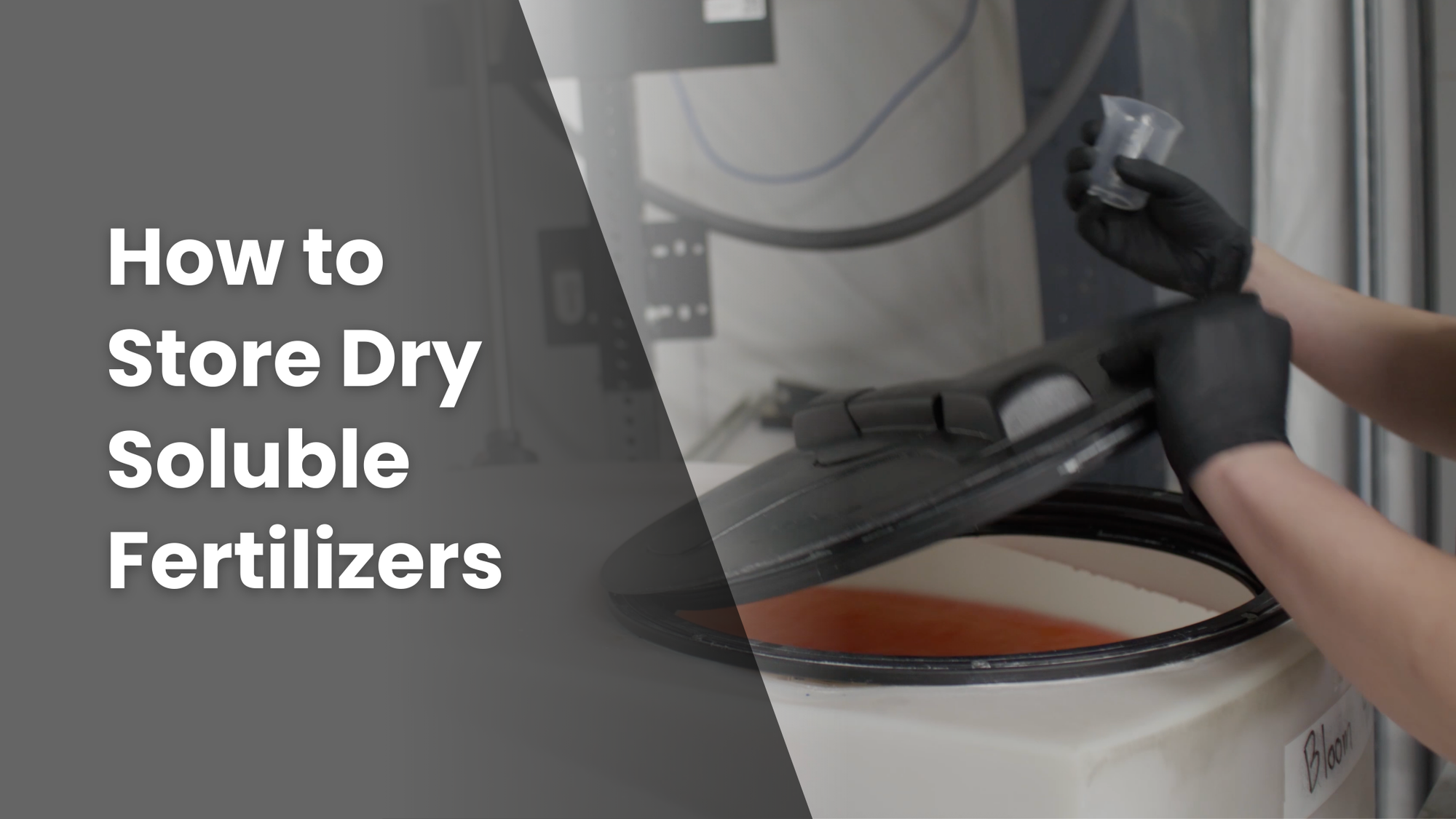
- This is critical for fertilizer clumping prevention. Always re-seal bags and containers immediately and thoroughly after each use. For partially used products, transfer to airtight bins or sturdy buckets with tight-fitting lids. Double-bagging adds extra protection for hygroscopic components. Create an impenetrable fortress against atmospheric moisture.
- Smart Placement Strategies
- Never store fertilizer bags directly on concrete floors; concrete can wick moisture upwards. Utilize pallets or sturdy shelving to elevate bags, promoting air circulation and preventing moisture transfer. Keep fertilizers away from direct sunlight, heat sources, open liquids, and strong oxidizers to prevent accidental reactions or degradation.
- Inventory Management for Freshness
- Implement a robust FIFO (First-In, First-Out) inventory system. When new shipments arrive, ensure older stock is used first. Clearly label all bags and containers with delivery or opening dates. This ensures consistent use of the freshest product, maximizing dry fertilizer shelf life and preventing long-term vulnerability to environmental degradation.
- Proactive Problem Solving
- Integrate regular inspections of your stored fertilizers into your operational checklist. Look for any signs of clumping, discoloration, or moisture inside packaging. Address issues promptly. If a mild clump is detected, it may still be salvageable with vigorous mixing upon dissolution, but severe hardening usually indicates degradation. Rotate stock periodically to prevent long-term stagnation.
Frequently Asked Questions: Dry Fertilizer Storage
How does fertilizer clumping affect the accuracy of my nutrient solution's EC, especially when following a specific Front Row Ag feed chart recipe?
Clumping directly impacts the concentration of dissolved nutrients. If a fertilizer doesn't fully dissolve or is unevenly distributed due to clumping, your actual EC will be lower than intended. This leads to nutrient deficiencies, even if your scales show the correct weight was added, because the soluble concentration is off. This undermines the precision of your nutrient delivery, which is designed to hit specific targets for growth phases like "Stretch" or "Swell."
Can I recover clumped water soluble fertilizer, or is it always a loss?
Mildly clumped fertilizer can sometimes be broken down and dissolved, but it often requires extra labor and meticulous stirring to ensure full solubility. This often means extending the agitation time or even pre-dissolving small portions. Severely hardened product is generally a loss, as its chemical integrity may be compromised, leading to unpredictable results and potential blockages in irrigation systems. It's usually more cost-effective to prevent clumping than to attempt recovery, given the labor cost and risk to crop health.
Beyond dry bulk, are there storage considerations for mixed liquid stock concentrates?
Yes, absolutely. Once dry fertilizers are mixed into liquid stock concentrates, their stability changes. Front Row Ag recommends using stock concentrates within 2-4 weeks. This guideline is crucial because mixed solutions, even when stored in opaque, climate-controlled containers, are susceptible to microbial growth and chemical changes over time. Unlike dry inputs, which are stable for extended periods under ideal conditions, the act of dissolving them in water creates a new, more dynamic chemical environment that requires a shorter shelf life for optimal performance.
Ensuring Predictability in Your Cultivation
In the complex ecosystem of modern cultivation, every variable must be meticulously managed to achieve consistent, high-quality yields of specialty cultivars. The humble act of knowing how to store dry soluble fertilizer holds significant sway over the ultimate success of your operation.
Investing in proactive, data-driven storage practices isn't merely an operational expense, it's an essential component of maintaining product integrity and operational efficiency. By safeguarding the purity and solubility (knowing how to store dry soluble fertilizer), cultivators gain unparalleled predictability in nutrient delivery. This foresight translates directly into tangible benefits, protecting against costly crop issues stemming from inconsistent feeding, minimizing product waste, and freeing up invaluable labor hours for tasks that directly enhance crop value. Embrace precision and consistency from the very first step of your nutrient program, and witness the transformative return on investment in your cultivation efforts. Ready to optimize your nutrient program with precision and predictability? Contact Front Row Ag today to discuss your facility's specific needs and explore our premium dry soluble fertilizers.